French press articles translated for you
HAUT-VAR : It’s always five to noon (p75-76)
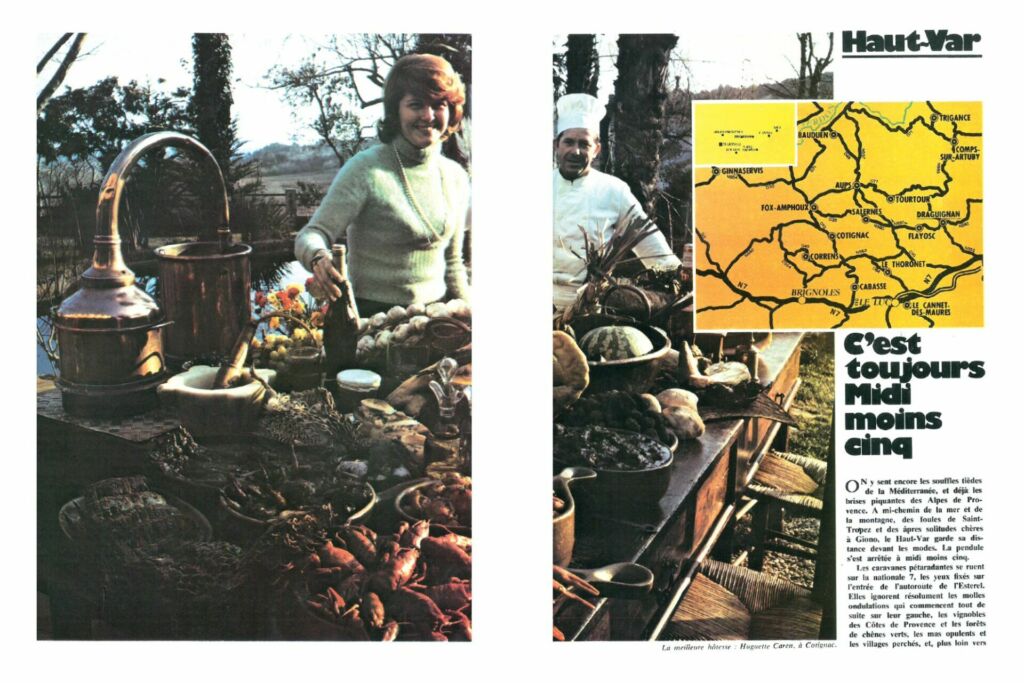
Photo caption: The finest hostess: Huguette Caren, in Cotignac.
Here one still feels the mild breath of the Mediterranean, and already the bracing breeze from the Alps of Provence. Midway between sea and mountain—far from the crowds of Saint-Tropez and the austere solitudes beloved of the novelist Jean Giono—the Haut-Var keeps its distance from fashion. Here the clock has stopped at five to noon.
Roaring caravans rush along Route Nationale 7, eyes fixed on the Esterel motorway entrance. They pass, oblivious to the gentle undulations beginning just to their left: the vineyards of the Côtes de Provence, forests of green oak (holm oak), handsome stone farmhouses (mas), hilltop villages—and farther north, the vast garrigue and empty heaths the army turned into firing ranges, rising in a soft incline until the land drops, all at once, into the Grand Canyon of the Verdon.
Here, travel and food guides tend to dismiss this enclave of gentleness and gravity with a quick nod. Yet the Haut-Var deserves far more than a glance. The Cistercian abbey of Le Thoronet stands among the summits of Western architecture. Old villages abound, with courtyards shaded by plane trees (platanes), warm bistros, and Romanesque churches where splendid gilded wooden retables shine (don’t miss Cabasse). Quiet roads wind among the “plans” (little plains), fragrant with Provençal herbs. People here have not yet been spoiled by tourism. And beneath the round Roman tiles you’ll find lovely inns serving simple, wholesome food, rich with the good flavors of earlier days.
Go taste the gigots roasted by the lovely Huguette Caren in Cotignac; the truffled brouillade made by good Mme Tholozan in Tourtour; and Juliette Cotton’s daube in Flayosc. If you want to sleep in peace and great comfort, make your way up to La Bastide de Tourtour—or better yet, to Lou Calen in Cotignac, the best address of all. There you’ll forget the crowds, the bluster, and the potshots of the Coast. And there are other good addresses we’ve found besides. Here they are.
CORRENS:
seen from the bridge
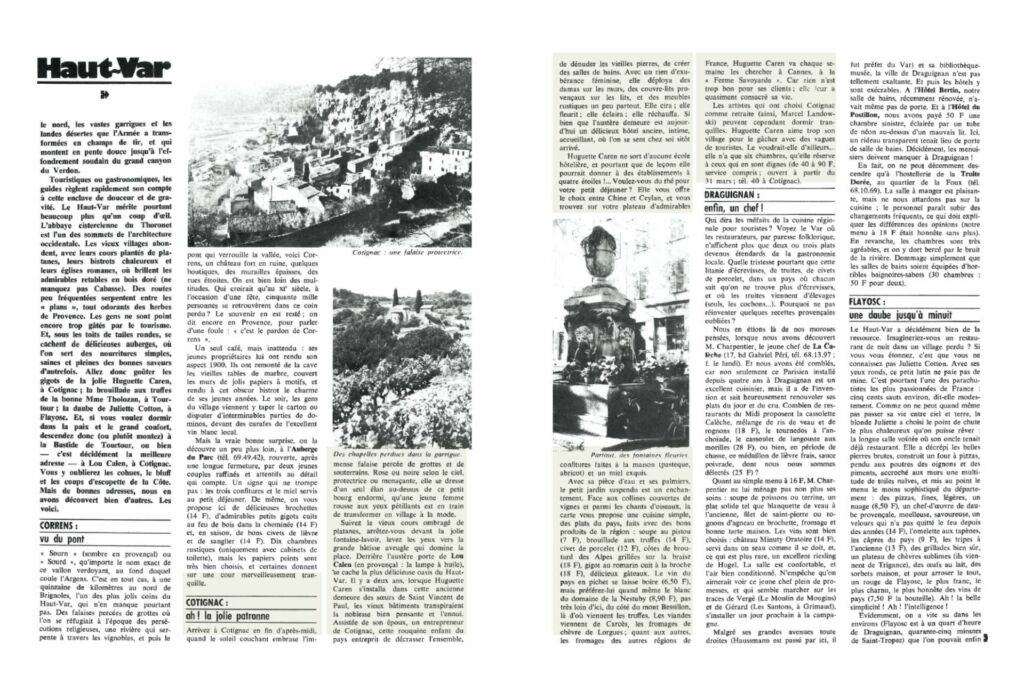
“Sourn” (dark, in Provençal) or “Sourd”(deaf, in French)—whatever the exact name of this green valley with the Argens river running at its feet. About fifteen kilometers north of Brignoles, it’s one of the prettiest corners of the Haut-Var, which has no shortage of them. Cliffs riddled with caves where people once hid during religious persecutions, a river winding through vineyards, then the bridge that locks the valley: this is Correns—fortress ruins, a few shops, thick walls,
narrow streets. We are far from the crowds. Who would believe that in the 11th century, during a festival, fifty thousand people gathered in this lost nook? The memory remains; in Provence, to speak of a throng, one still says: “c’est le pardon de Correns.”
There’s just one café, but an unexpected one: its young owners have given it back its 1900s look. They hauled old marble tables up from the cellar, papered the walls with charming prints, and restored to this once-dim bistro the charm of its youth. In the evening, villagers come to play cards or endless rounds of dominoes, with carafes of excellent local white wine.
The real pleasure lies a little farther on, at the Auberge du Parc, reopened after a long closure by two young couples with refined taste and an eye for what matters. A sure sign: three house jams and honey at breakfast. You’ll also find delicious skewers, admirable little legs of lamb cooked over the open fire in the hearth, and, in season, fine hare and wild-boar stews. Ten rustic rooms (toilet only), but the wallpapers are perfectly chosen, and some look onto a wonderfully quiet courtyard.
COTIGNAC:
ah! the lovely proprietress
Arrive in Cotignac late in the afternoon, when the setting sun sets fire to the immense cliff pocked with caves and tunnels. Pink or dark blue hues depending on the sky, protective or menacing, it rises in a single sweep above the sleepy little town that a young red-haired woman with sparkling eyes is in the midst of turning into a fashionable village.
Follow the old plane-tree-shaded Cours, stop at the pretty fontaine-lavoir (wash-house fountain), lift your gaze to the great timeworn façade that dominates the square. Behind the austere door of Lou Calen (in Provençal: “the oil lamp”) lies the most delicious oasis in the Haut-Var. Two years ago, when Huguette Caren moved into this former house of the Sisters of Saint-Vincent-de-Paul, the old buildings exuded respectable propriety—and boredom. With her husband, a contractor from Cotignac, this red-haired daughter of the region set about scrubbing everything clean, stripping the old stones, adding bathrooms. With a deft, feminine exuberance she hung damask on the walls, laid Provençal coverlets on the beds, and scattered rustic furniture here and there. She polished. She brought flowers. She brightened and warmed the rooms. The once-austere house is now a delightful old hotel, intimate and welcoming, where you feel at home the moment you arrive.
Huguette Caren never received a hospitality degree, and yet what lessons she could give to many a four-star establishment. Tea at breakfast? She offers China or Ceylon, and on your tray, you’ll find admirable house-made jams (watermelon, apricot) and exquisite honey.
With its reflecting pool and palm trees, the small hanging garden is enchanting. Facing vine-covered hills and birdsong, the menu offers simple, local cooking made with the region’s best:
soupe au pistou, truffle scramble, hare stew, grilled ribs of Alpine broutard (yearling beef) over coals, spit-roasted leg of lamb with rosemary, and lovely cakes. The local wine by the pitcher goes down easily, though the white from Domaine de la Nestuby, not far from here on the slopes of Mont Bessillon where the truffles come from, is better still. Meats come from Carcès, goat cheeses from Lorgues; as for other cheeses from elsewhere in France, Huguette Caren fetches them each week in Cannes at the Ferme Savoyarde. Nothing is too good for her guests; she has practically devoted her life to them.
The artists who have chosen Cotignac as a retreat (Marcel Landowski, for example) can sleep soundly. Huguette Caren loves her village too much to let waves of tourists spoil it. Would she even want to? She has only six rooms, which she reserves for those who deserve them, service included; open from March 31.
DRAGUIGNAN:
at last, a chef!
Who will call out the harms of “regional cuisine” for tourists? Look at the Var, where restaurateurs—out of lazy folklore—offer only two or three dishes turned into banners of local gastronomy. How sad, this litany of crayfish, trout, and pork stews in a place where everyone knows there are no crayfish anymore and the trout are farmed (only the pigs…). Why not revive a few forgotten Provençal recipes?
Our gloom lifted when we discovered M. Charpentier, the young chef at La Calèche (17, boulevard Gabriel Péri). A Parisian who settled in Draguignan four years ago, he’s an excellent cook, inventive, and happily refreshes both the daily specials and the classics. How many restaurants in the Midi offer things like: a Calèche casserole, ris of veal with kidneys, tournedos with anchoïade, langouste casserole with morels, or, in hunting season, fresh hare medallion, pepper sauce?
Even the simple 16-franc menu gets real care: fish soup or terrine, a sturdy main such as blanquette de veau, old-style, fillet of john dory (saint-pierre) or lamb kidneys on a skewer, then cheese and a good house tart. The wines are well chosen: Château Minuty Oratoire, properly served in an ice bucket, (and rarer ) an excellent Hugel riesling. The room is comfortable, the air well conditioned. One can’t help wishing this promising young chef—who seems to be following in the footsteps of Vergé (Le Moulin de Mougins) and Gérard (Les Santons, in Grimaud)—would someday set up in the countryside.
Despite its broad straight avenues (Haussmann was once prefect here) and its library-museum, Draguignan isn’t especially thrilling. And the hotels are dreadful. At the Hôtel Bertin, our recently renovated bathroom didn’t even have a door. At the Hôtel du Postillon, we paid 50 francs for a grim room lit by a neon tube over a poor bed; there, a sheer curtain stood in for a bathroom door. Clearly, carpenters are in short supply in Draguignan!
In truth, the only proper option is the Hostellerie de la Truite Dorée, in the La Foux quarter. The dining room is pleasant, but we won’t linger on the kitchen; staff turnover seems frequent, which may explain the mixed opinions (our 18-franc menu was decent, no more). The rooms, however, are very nice, and you fall asleep to the sound of the river. It’s a pity the bathrooms are fitted with those horrible hip baths (baignoires-sabots).
FLAYOSC:
a daube served till midnight
The Haut-Var never runs out of surprises. Imagine a late-night restaurant in a tucked-away village. If that shocks you, you don’t know Juliette Cotton. With her round eyes, this sprightly sprite looks unassuming—yet she’s one of France’s most ardent parachutists: about five hundred jumps, she says, modestly.
Since one can’t live forever between sky and earth, blonde Juliette chose the warmest landing spot one could dream up: the long-vaulted dining room, where her uncle once kept a restaurant. She stripped the walls back to their beautiful stone, built a pizza oven, hung onions and peppers from the beams, covered the walls with naïf paintings, and devised the district’s most sophisticated menu: pizzas, thin and light, a cloud; a masterwork of Provençal daube, tender and full of flavor, a velvet that has stayed on the fire for years; an omelet with tapènes—local capers; tripe, old-style; proper grilled meats; a platter of superb goat cheeses (from Trigance); œufs au lait; house sorbets. To drink: a red from Flayosc, the frankest, fleshiest, most honest of country wines. Ah, the beauty of simplicity. Ah, the intelligence of it.
Naturally, word spread quickly in the area (Flayosc is fifteen minutes from Draguignan, forty-five from Saint-Tropez) that you could at last…
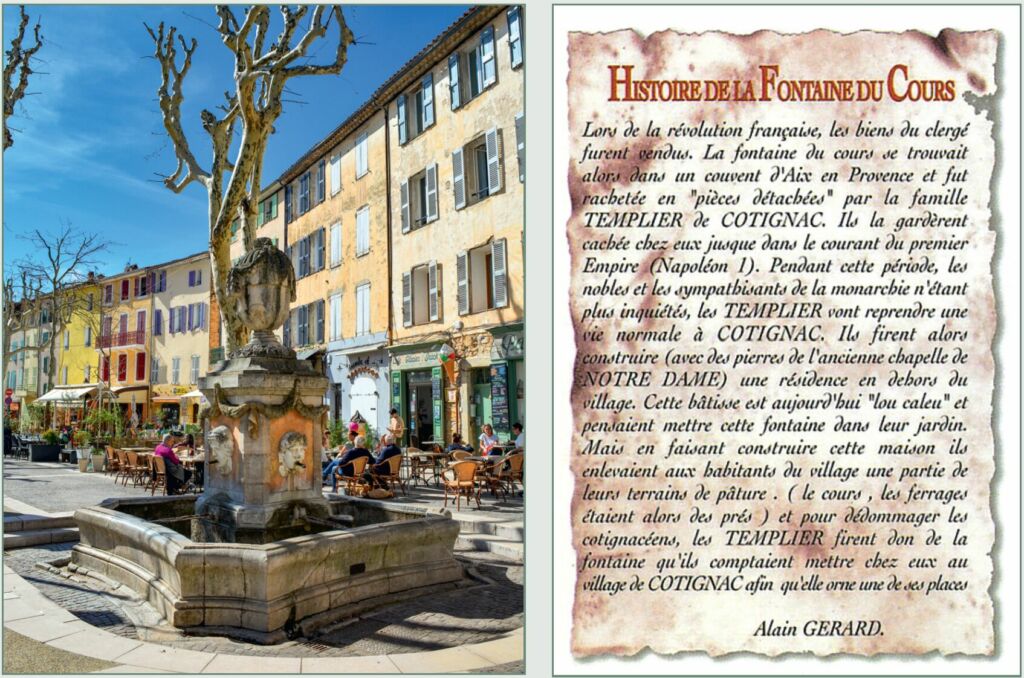
History of the Cours Fountain (p.87)
During the French Revolution, church property was sold off. The Cours fountain was then housed in a convent in Aix-en-Provence and was purchased “in separate pieces” by the Templier family of Cotignac. They kept it hidden at home until the First Empire (Napoleon I). When nobles and royalist sympathizers were no longer being persecuted, the Templiers resumed normal life in Cotignac. They built a residence outside the village, using stones from the former chapel of Notre-Dame. That building is now, Lou Calen. They initially planned to place the fountain in their garden. But in constructing this house, they were taking part of the villagers’ grazing land (at the time, the Cours and Ferrages were meadows). To compensate the people of Cotignac, the Templiers donated the fountain that was intended for their home, to the village of Cotignac so it could adorn one of its squares.
Alain Gérard